

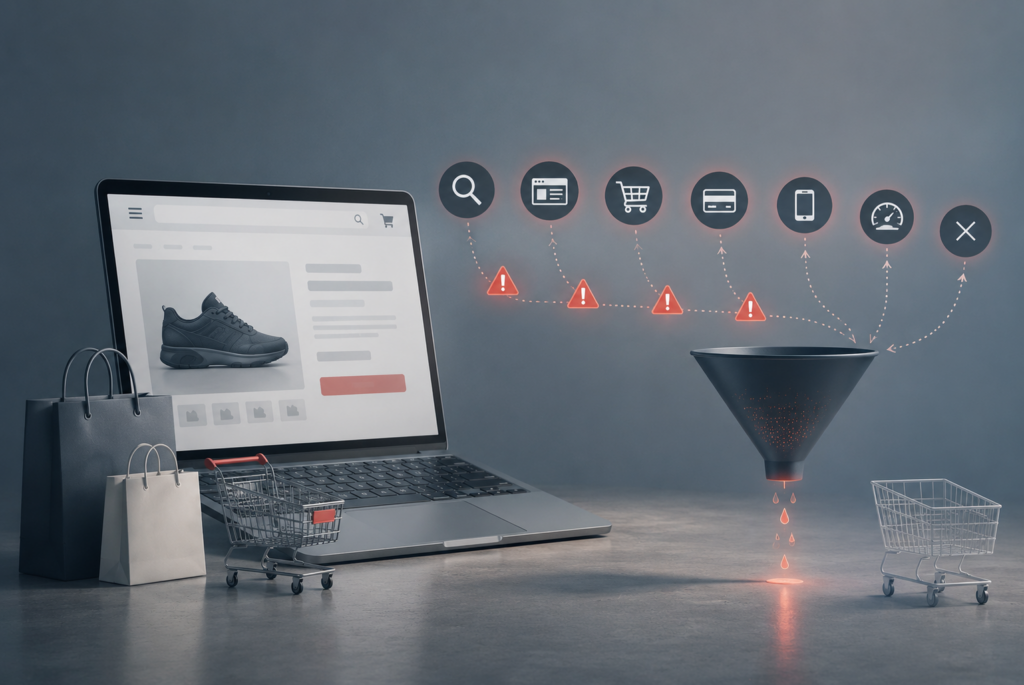
Discover the most common friction points in an online store and how to optimize navigation, checkout, payments, and the mobile experience.
An ecommerce store can receive a high volume of traffic and still fail to generate enough sales. In many cases, the problem isn’t a lack of visitors—it’s the experience they encounter once they arrive. If you’re wondering how to increase your online store’s sales, the answer often lies in removing the obstacles that interrupt the customer journey.
Below are the seven main friction points that affect your store’s conversion rate and the overall digital shopping experience.
Analyzing Friction Throughout the Customer Journey
The following table connects each friction point with the experience it creates, its impact on conversion, what you should review, and the KPI you can use to measure it.
The 7 Ecommerce Friction Points
| Friction Point | User Experience | Impact on Conversion | What to Review | Suggested KPI |
| 1. Confusing Navigation | Users feel lost or can’t find logical product categories. | Frustration leads visitors to leave the site prematurely. | Menu hierarchy, clear labels, and breadcrumbs. | Bounce Rate |
| 2. Ineffective Search | Search returns poor results or fails to recognize synonyms. | Users assume the product they want isn’t available. | Search functionality, autocomplete suggestions, and filters. | % of Searches With No Results |
| 3. Incomplete Product Information | Customers have unanswered questions about dimensions, materials, or compatibility. | Uncertainty prevents them from making a purchase decision. | Product pages, high-quality images, and sizing guides. | Add-to-Cart Rate |
| 4. Slow Loading Speed (Mobile) | Users wait too long for images, pages, or menus to load. | Visitors close the page before it fully loads. | Image sizes, unnecessary scripts, and hosting performance. | Load Time (LCP) and Core Web Vitals |
| 5. Unexpected Costs | Customers encounter unexpected taxes or shipping fees at the end of the process. | Shoppers abandon their carts at the final stage. | Full cost transparency starting on the product page. | Cart Abandonment Rate |
| 6. Complicated Checkout | Customers face endless forms or are forced to create an account. | Checkout fatigue causes customers to lose their purchase momentum. | Guest checkout options and fewer required fields. | Checkout Completion Rate |
| 7. Lack of Follow-Up | Customers are unsure whether their order was successfully processed after payment. | Customer anxiety increases along with support requests. | Automated confirmation emails and shipment tracking. | Net Promoter Score (NPS) |
The Importance of Proactive Transparency
To improve the shopping experience, anticipate your customers’ questions before they have to ask. Make the following information clearly visible before they begin the checkout process:
- Return policies: Build trust and reduce the fear of making the wrong purchase.
- Delivery times: Knowing when a product will arrive can be a deciding factor.
- Payment methods: Customers should immediately see whether their preferred payment options are available.
- Stock availability: Avoid the frustration of discovering that a product is out of stock at the final stage of the purchase.
- Customer support options: Visible live chat or access to a real person adds a human element to the brand experience.
Conclusion
Shopping should feel simple. Every unanswered question and every unnecessary step increases the likelihood of abandonment. Your store’s conversion rate depends directly on how seamless the journey is from the moment a customer discovers a product to the moment they receive their order confirmation.
At Adverweb, we help identify these friction points and eliminate them—often by connecting and automating the tools your ecommerce store already has in place. Go through your store today as if you were a first-time customer: at what point did you feel like leaving? Let’s talk.